
Solution
Investigations and SIU
Give investigators AI-assisted research, structured reporting, and image intelligence that reduce dead time and improve case clarity.
Buyer: SIU leaders, investigation managers, and intelligence teams
Faster case progression, more structured evidence, and clearer escalation paths.
Built to hold up in executive and operational review
Buyer
SIU leaders, investigation managers, and intelligence teams
Faster case progression, more structured evidence, and clearer escalation paths.
Investigators lose time to scattered evidence collection and inconsistent synthesis, especially in higher-volume workflows.
Investigation teams are expected to move faster without sacrificing the defensibility that claims and legal teams rely on.
Carpe approach
Workflow snapshot
Before Carpe / After Carpe
What changes in daily execution when teams move from manual signal collection to workflow-ready intelligence.
Before Carpe
After Carpe
Operating view
What this looks like inside a carrier.
Outputs
Why this works inside a carrier
Workflow proof
Real product context around the solution.
See how the product fits into day-to-day carrier operations.
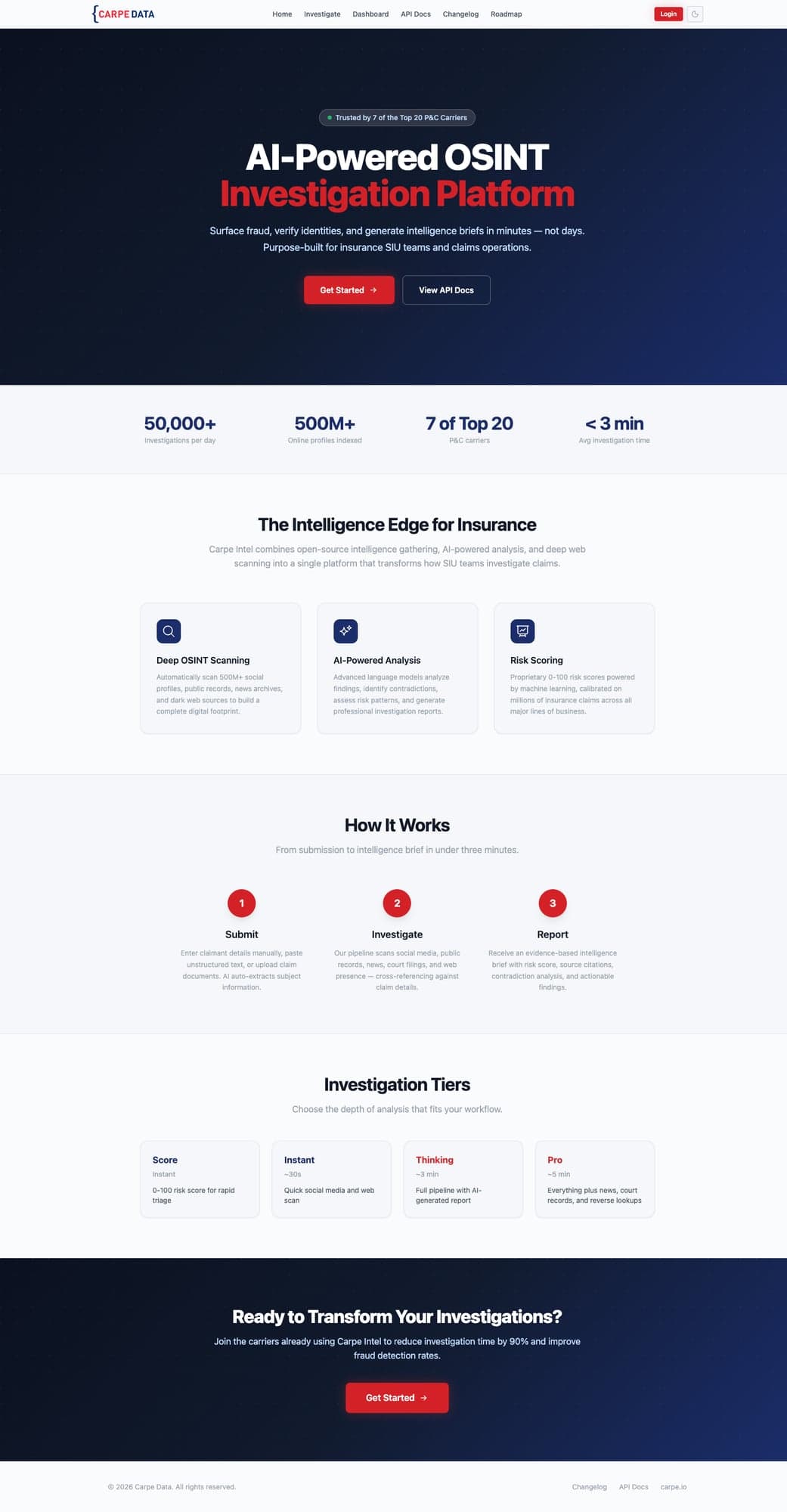
Investigators move from lead to review-ready output with a clearer case workspace.
Products involved
Products that make the solution concrete.
Each product maps directly to the capabilities that make this solution work.
Investigations
Investigative Reports
Carrier-grade investigations that turn raw signal into actionable evidence.
Role in the solution
Give investigators a sharper starting point and higher-confidence output on every case.
OSINT investigations
Carpe Intel
AI-assisted investigation workflows that help teams move from lead to answer with speed and structure.
Role in the solution
Increase investigative throughput without sacrificing trust or defensibility.
Computer vision
Carpe Vision
Image intelligence that adds visual signal detection to modern insurance workflows.
Role in the solution
Extract more structured insight from visual evidence, faster and with better consistency.
Implementation
Launch with clear milestones.
Pilot in 4-6 weeks, broader SIU rollout over 60-90 days.
Objections
Common questions from carrier teams.
Answers buyers and operational sponsors ask during evaluation and rollout planning.
How is this different from our current investigation tools?
Carpe combines signal collection, synthesis, and reporting in one flow, reducing tool switching and producing outputs built for enterprise review.
Can we trust AI-assisted investigative output?
Output is structured for investigator validation with traceable evidence context, supporting defensibility instead of replacing investigative judgment.
How quickly can SIU teams adopt this?
Most teams start with a targeted case type, validate throughput and quality gains, then expand to broader investigative queues.
Will this reduce the role of experienced investigators?
No. It increases investigator leverage by removing low-value manual synthesis work and accelerating high-value case decisions.
Talk through this workflow with the Carpe team.
Get a solution-specific conversation tailored to the buyer, operating pressure, and products shaping this motion.