
OSINT investigations
Carpe Intel
AI-assisted investigation workflows that help teams move from lead to answer with speed and structure.
Primary buyer: SIU managers and intelligence operations leaders
Related workflow: Investigations and SIU
Increase investigative throughput without sacrificing trust or defensibility.
Overview
Carpe Intel brings together search, orchestration, synthesis, and analyst workflows so investigative teams can move from lead to defensible answer faster.
Investigation teams need more than search. They need an operating environment that helps them move from intake to answer without losing the thread.
Buyer and team
SIU managers and intelligence operations leaders
Workflow problem
Why teams buy this.
Teams need to move from lead to answer faster, but fragmented research tools slow collection, synthesis, and review.
Inputs and outputs
What the product looks at and what teams get back.
Inputs and signal sources
Outputs and deliverables
Data usage
What this product uses and what it does not.
Clear guardrails on data usage help teams evaluate fit, trust, and compliance readiness.
Data we use
Data we do not use
How it works in practice
The product in action.
See the product in context — how it captures signal, organizes findings, and delivers output into the workflow.
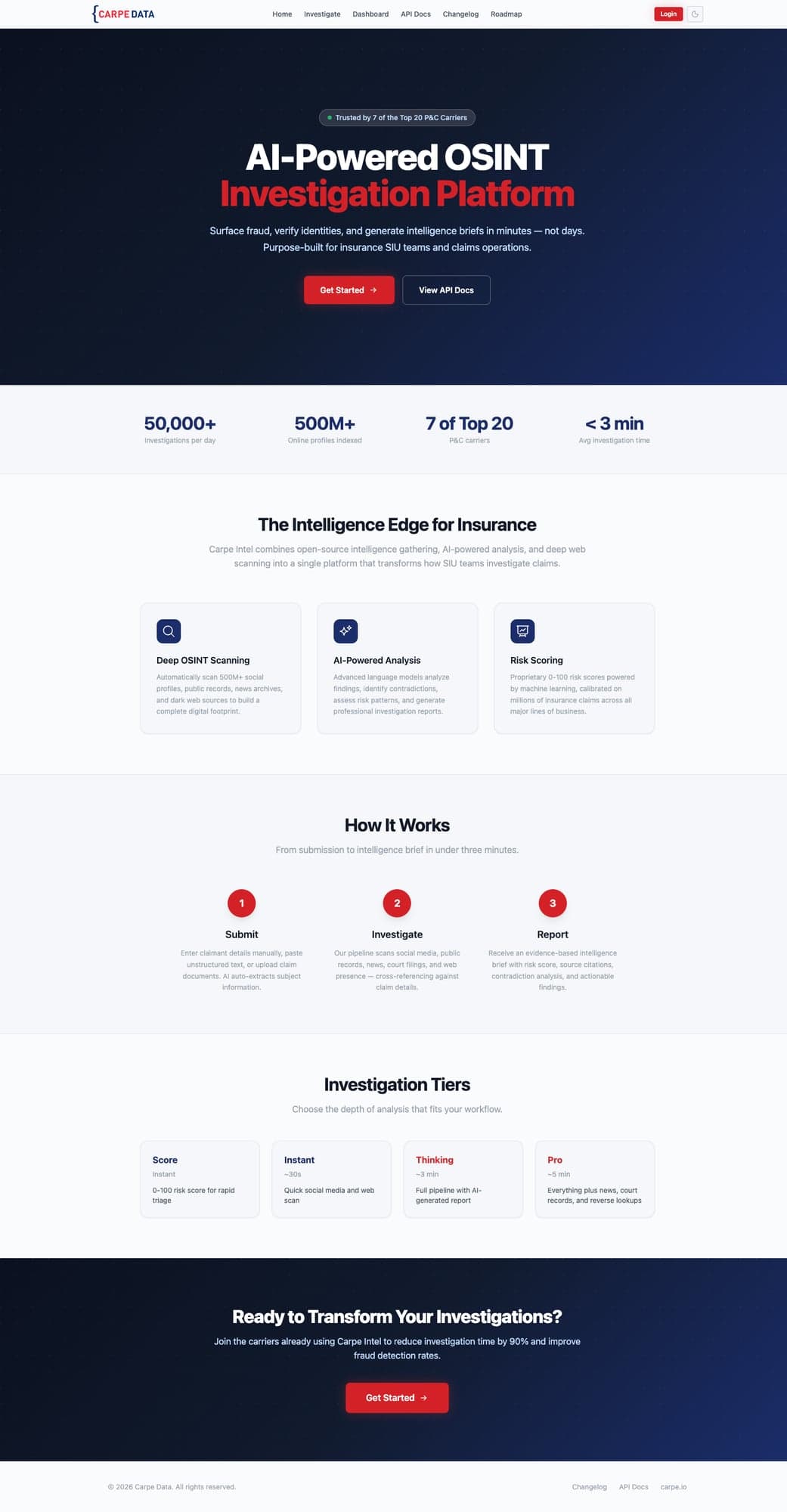
Collection, synthesis, and review live inside one investigative workspace.
Operating motion
How it works in practice.
Start
Begin with a lead, claim, subject, business, or entity.
Collect
Gather and organize the most relevant external signals.
Synthesize
Surface patterns, anomalies, and the findings that actually matter.
Route
Deliver a structured narrative for review, escalation, or downstream action.
Implementation
Implementation path and requirements.
4-6 weeks for initial SIU and intelligence team rollout.
Steps
Requirements
Why buyers trust it
Built for reviewable output and real workflow fit.
Enterprise buyers care about signal quality, output clarity, and whether the product fits how teams already make decisions.
Built around investigative operating flow, not generic search
Supports structured handoff and review
Scales researcher leverage without flattening nuance
Expansion path
Related products and the next logical motion.
This product sits inside the broader investigations and siu story and can expand into adjacent workflows cleanly.
FAQ
Questions teams ask before rollout.
Answers on data sources, implementation, pricing model, integration, and compliance.
Which data sources does Carpe Intel use?
Carpe Intel combines public web and business intelligence with your case context to produce structured investigative workflows.
What is the expected implementation timeline?
Teams typically deploy an initial workflow in 4-6 weeks, then extend to more case categories once performance is validated.
How is pricing structured?
Pricing generally maps to investigative usage, case volume, and deployment depth for SIU and intelligence teams.
Can it integrate with our case management process?
Yes. Outputs are built for handoff and escalation into existing investigative and claims operating models.
How do you support compliant use?
The workflow is designed with clear case boundaries, reviewable output, and governance controls for enterprise usage.
See this product in a live workflow walkthrough.
Carpe can tailor the conversation around the buyer, the operating problem, and the adjacent products that matter most for adoption.